How a tul is scored: deductions, rhythm and sine wave
A competition pattern is scored in two stages. While it lasts, the umpire subtracts: they start at 6 points and deduct each mistake they see, at the moment they see it. When it ends, the umpire adds: up to 4 more points for the rhythm, sine wave and power of the whole pattern. Each umpire's score is a vote, and the competitor with more votes wins.
This guide explains the procedure as the ITF's current rules of competition write it: what counts as a mistake, what sends a performance to zero, and what changed from earlier versions.
Which rulebook. This guide follows the Official ITF Rules of Competition version 2026-1, published by the ITF at itftkd.sport. Other organisations also call themselves ITF and score patterns differently. Before a tournament, check which rulebook and which version it uses.
The format: two competitors, the same tul, at the same time
At a world championship the individual pattern is fought one against one: red and blue perform at once, facing the table. Each performs two designated patterns for their degree:
- The first is drawn from the last three patterns of their degree.
- The second is drawn from all the others, from Chon-Ji up to their degree.
- The electronic system draws them, overseen by the Jury President.
At a World Cup, coloured belts perform one designated pattern, drawn from the last three of their rank. Black belts perform one in the elimination rounds and two in the final. If the two competitors clash during the performance, whoever caused the clash scores zero for that pattern.
Faults before and after the performance: one full point
Version 2026-1 adds a fault deducted before or after the pattern, not during it. It costs one full point, and applies at most once per pattern:
- Performing Charyot Sogi incorrectly: crossing the arms in preparation, stamping when coming to attention.
- Not walking directly from the edge of the ring to the starting position.
- Stamping while entering the ring.
- Pausing on the way in or out to perform a technique or action.
- Unsportsmanlike behaviour.
Level one: start at 6 and deduct 0.2 per mistake
Each umpire starts with 6 points per competitor and deducts 0.2 for each mistake, every time it happens, up to a maximum of 6 points. The rules give a list of examples and say explicitly that it is not exhaustive:
- Not calling the pattern's name, or calling the wrong one.
- Shouting or kihap at any time, including at the end.
- A technique at the wrong height or with the wrong alignment.
- Losing balance.
- Not returning to the starting spot, within one shoulder radius.
- Returning to the starting spot on the wrong foot.
- Stepping out of the ring.
- Inaccurate stepping: foot placement after a kick, spot turns, pivots, shifting.
- Incorrect preparation or execution of a technique.
- Incorrect stance.
- Incorrect motion: continuous, connecting, slow, fast, natural.
- Attacking or defending with the wrong technique.
- Holding or retracting a kick incorrectly for its technical definition.
- Hesitating or stopping for more than a split second.
- Lack of power, or power applied incorrectly, in a movement.
- Incorrect breathing in a movement or a combination.
- Incorrect sine wave in a movement.
What sends a tul to zero
Some faults are not deducted: they cancel the whole performance. The umpire gives zero points for:
- Stopping the pattern completely, or pausing for more than 2 seconds.
- Performing a pattern other than the designated one, or one outside the competitor's degree.
- Starting in the wrong direction.
- Starting from a ready posture other than the pattern's own.
- Adding or omitting movements, or changing their sequence.
- Not completing the sequence of steps that makes up the pattern's diagram.
Note the difference between hesitating and stopping. A doubt longer than a split second costs 0.2. A pause longer than 2 seconds costs the pattern. Between the two lies a stretch where the umpire decides, and that is where a panel's scores drift furthest apart.
Level two: add up to 4 points at the end
When the performance ends, the umpire adds, in steps of 0.5:
- Up to 2 points for the rhythm and sine wave of the whole pattern.
- Up to 2 points for the power of the whole pattern.
Sine wave is ITF Taekwon-Do's signature: the body drops, rises and drops again in every step to carry its mass into the technique. Rhythm is the timing between movements that the pattern's technical description prescribes.
Note that sine wave and power appear twice. A specific movement without wave or without power costs 0.2 at level one. The impression of the whole pattern is rewarded, or not, at level two. The maximum is still 10: 6 with no mistakes plus 4 for the final mark.
How the model changed
| Rules version | Starts at | Mistakes during the pattern | At the end |
|---|---|---|---|
| Appendix 1, 2015 amended 2017 | 10 | Up to 6 deducted, in 0.2 steps | Up to 2 deducted for rhythm and wave and up to 2 for power, in 0.5 steps |
| Rules of Competition 2022v1 | 10 | Up to 10 deducted, in 0.2 steps | Nothing: rhythm and wave were deducted movement by movement |
| Rules of Competition 2026-1 | 6 | Up to 6 deducted, in 0.2 steps | Up to 2 added for rhythm and wave and up to 2 for power, in 0.5 steps |
For an umpire, the 2026 change is one of mindset: the final mark is no longer a penalty, it is a reward to be decided. And you have to reach the end of the pattern with a formed impression of the whole pattern's rhythm and power, on top of the count of mistakes.
How the winner is decided
The electronic system works out each competitor's score from what each umpire gave at both levels. But the highest average does not win: each umpire votes for the competitor they gave more points to, and the winner is the one with the majority of votes, with at least two in their favour. In a draw, another designated pattern is drawn, without repeating the previous ones, until there is a winner.
That design already assumes the umpires will not agree. What it guards against is one umpire's disagreement deciding the match alone.
How to practise scoring a tul
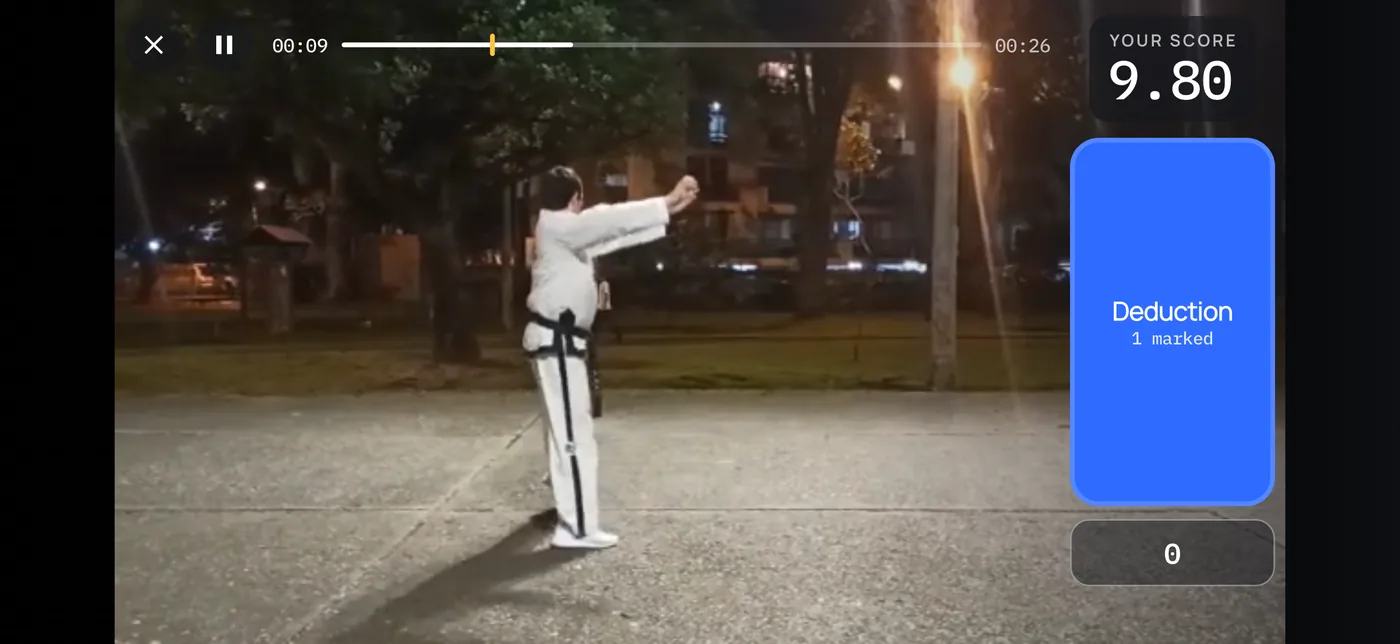
Knowing the list is not knowing how to judge. What sets one umpire apart from another is how many of those mistakes they see, in time, and how they decide the borderline cases and the final mark. That is only trained by scoring:
- Score in one pass. There is no pause or rewind at the table. If you practise pausing the video, you are practising something else.
- Mark each mistake when it happens, not at the end. With a clicker, one tap is 0.2.
- Compare against a reference. Your score alone says nothing. Against an expert judge's, or against the median of many judges, it tells you whether you are strict, lenient or inconsistent.
- Look at where you split off, not only by how much. A 0.2 gap can be a mistake you missed, or one you saw that others did not.

Frequently asked questions
From how many points is an ITF tul scored?
From 6, under version 2026-1 of the ITF's rules of competition. The umpire deducts 0.2 for each mistake up to a maximum of 6, and at the end adds up to 4 points for rhythm, sine wave and power. The maximum is still 10.
How much is deducted for each mistake in an ITF tul?
0.2 points for each mistake, every time it happens. Faults before or after the performance, like an incorrect Charyot Sogi or stamping on the way in, cost one full point, once per pattern.
Does kihap cost points in a competition pattern?
Yes. The ITF's rules of competition deduct 0.2 for shouting or kihap at any point of the pattern, including at the end.
What makes a tul score zero?
Stopping completely or pausing for more than 2 seconds, performing a pattern other than the designated one, starting in the wrong direction or from another ready posture, and adding, omitting or reordering movements.
How are rhythm and sine wave scored?
In two ways. A movement with an incorrect wave costs 0.2 on the spot. At the end, the umpire adds up to 2 points for the whole pattern's rhythm and wave, and up to 2 for its power, in steps of 0.5.
Does the highest score win?
The competitor with the majority of the umpires' votes wins, with at least two. Each umpire votes for the competitor they gave more points to. In a draw, another designated pattern is performed.
Sources
- ITF, Official ITF Rules of Competition, version 2026-1: article T26 and the individual pattern scoring procedure.
- ITF, Official ITF Rules of Competition, version 2022v1 and Umpire Rules, Appendix 1 (2017): the earlier models.