The 7 mistakes judges miss most in a pattern
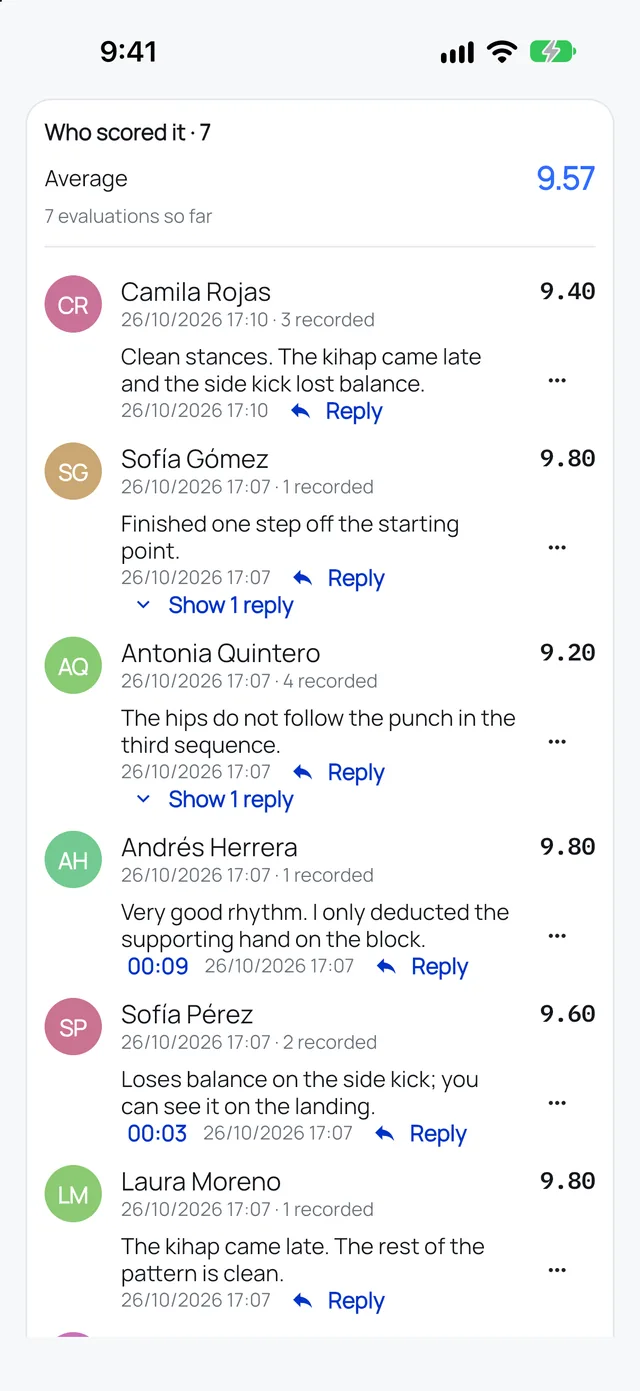
A pattern umpire does not lose precision on the big mistakes. The whole panel sees those. They lose it on the small ones that happen while attention is somewhere else: before the first movement, at the end, or hidden inside a technique that looks fine.
This list comes from the penalties in the Official ITF Rules of Competition version 2026-1, published by the ITF at itftkd.sport. Almost all of them cost 0.2 every time they happen, and one costs a full point. They are not the most serious. They are the ones missed most.
1. The pattern's name
Not calling the pattern's name, or calling the wrong one, costs 0.2. It happens before the performance starts, while the umpire is still settling the score sheet, watching the other competitor or waiting for the signal. It is the first possible mistake and the one most often missed by arriving late.
How not to miss it: attention starts when the competitor is in position, not when they move.
2. The kihap
The rules deduct shouting or kihap at any point of the pattern, including at the end. For many umpires trained in the dojang, kihap is a natural part of a pattern and the ear does not register it as a mistake. In competition it is one, every time.
How not to miss it: listening is part of judging. A kihap at the end, when you have already looked down to write, still counts.
3. The return: the starting spot and the foot
At the end, the competitor has to return to the starting spot, within one shoulder radius. Not returning costs 0.2. Returning on the wrong foot costs another 0.2. They are two separate mistakes and can happen together.
It is the moment attention drops: the pattern is "over", the umpire starts closing their score. And the return to the spot is judged by looking at the floor, not at the competitor.
How not to miss it: mark the starting spot in your mind before the start. The pattern ends when the competitor stands still on that spot.
4. The entry and the exit: one full point
Version 2026-1 deducts one full point, once per pattern, for faults that happen before or after the performance:
- An incorrect Charyot Sogi: crossing the arms in preparation, stamping when coming to attention.
- Not walking directly from the edge of the ring to the starting position.
- Stamping on the way in.
- Pausing on the way in or out to perform a technique or action.
It is the most expensive deduction on the list, and it happens when the umpire has not yet "started judging", or has already finished. Many still treat it as protocol rather than score.
How not to miss it: for the umpire, the pattern starts when the competitor enters the ring, not when they call its name.
5. Sine wave inside the movement
In version 2026-1 sine wave counts twice. An incorrect wave in a specific movement costs 0.2 on the spot. And at the end, the umpire adds up to 2 points for the whole pattern's rhythm and wave.
The typical mistake is to save the wave for the final mark: watch the whole pattern, decide at the end that it "had little wave", and never have marked a single movement. That loses the level-one deductions and leaves the final mark with nothing behind it.
How not to miss it: watch the competitor's head against the background. The wave shows in the line of the head: down, up, down. Every flat step is a tap, and the sum of what you saw is your final mark.
6. The kick: holding and retraction
Every kick has a technical definition of how it is held and how it is retracted. A kick held when it should not be, or not withdrawn as its definition says, costs 0.2. It happens fast, after the impact, when the eye has already moved to the next movement.
How not to miss it: in kicks, the technique does not end at the impact. Keep watching the leg until the foot is back on the floor.
7. Height and alignment
The rules deduct a technique at the wrong height or with the wrong alignment. Height is judged against the competitor's own body, not against a fixed line, and alignment against the direction set by the pattern's diagram. From one end of the table, a middle punch can look high and a skewed line can look straight.
How not to miss it: know the target of every technique in the pattern. You cannot judge the height of a strike when you do not know where it is aimed.
And the one that is not a 0.2 mistake
A pause of more than 2 seconds is not deducted: it cancels the pattern. A hesitation longer than a split second costs 0.2. A stop longer than 2 seconds scores zero for the whole performance. Between the two lies a stretch where each umpire decides, and it is one of the most common reasons a panel splits.
Why they slip past, and how to train seeing them
None of these mistakes is hard to understand. They slip past because the umpire is looking at something else at that moment. Reading the list does not fix that: scoring many patterns and comparing what you saw with what others saw does.
The most useful part of that comparison is not the final score. It is the detail: at which second the panel deducted and you did not. That is the mistake you always miss.

Frequently asked questions
Does a kihap cost points in a competition pattern?
Yes. The ITF's rules of competition deduct 0.2 for shouting or kihap at any point of the pattern, including at the end.
Which faults cost a full point in a pattern?
Those before and after the performance: an incorrect Charyot Sogi, not walking directly to the starting position, stamping on the way in, or pausing on the way in or out. It applies once per pattern.
How much does not returning to the starting spot cost?
0.2 if the competitor finishes more than one shoulder radius from the starting spot, and another 0.2 if they return on the wrong foot.
What is the difference between hesitating and stopping in a pattern?
Hesitating for more than a split second costs 0.2. Stopping or pausing for more than 2 seconds scores zero for the whole pattern.
Sources
- ITF, Official ITF Rules of Competition, version 2026-1: individual pattern penalties.