How to become an ITF Taekwon-Do umpire
Umpires are not made by the course. The course teaches the rules and certifies that you know them. An umpire's eye is made afterwards, by scoring many performances and finding out where you split from everyone else.
This guide explains the formal path to becoming an international ITF Taekwon-Do umpire: the classes, the requirements, what a world championship asks for and what each official does in the ring. And it suggests how to prepare so that the course is not your only practice of the year.
Which rulebook. The requirements below come from the Official ITF Rules of Competition version 2026-1, published by the ITF at itftkd.sport. Each national federation runs its own courses and national umpire grades, and other organisations that call themselves ITF have a different system. Ask your federation which applies.
National and international umpires
Almost everyone starts as a national umpire, at their own federation's courses and tournaments. That is where the trade is learnt: sitting at the corner, keeping score in your head, lasting through a full day of brackets. Each country sets the requirements for that level.
The international level is certified by the ITF, and it is the one that qualifies you for world championships and World Cups. The rules define three official qualifications: Class A umpire, Class B umpire and IT-Umpire, who runs the electronic system.
The ITF umpire classes
| Qualification | Minimum age | Minimum degree | Also |
|---|---|---|---|
| Class B | 18 | 1st Dan | Take a Class B umpire course |
| Class A | 21 | 4th Dan | Hold the Class B certificate and take the Class A course |
| IT-Umpire | 18 | 1st Dan | Hold Class A or B and pass the ITF IT-Umpire course |
In all three, besides passing, you have to apply for and receive the official certificate. The course alone is not enough.
What a world championship asks for
Holding Class A does not seat you at a world championship corner. The rules also require:
- An official ITF umpire course within the two previous calendar years.
- An International Instructor Course (IIC) within the two previous calendar years.
- Being put forward by your national association. Only the national association sends the application, a single one per country, with all its applicants.
The rules' arithmetic is literal: year of the event minus year of the course must be 0, 1 or 2. For a 2027 world championship a 2025 course counts, a 2024 one does not.
A World Cup asks for Class B with the same two recent courses. It is the first international step.
What each official does in the ring
- Jury President: oversees the ring, verifies the pattern draw, passes points, warnings and fouls to the system, and settles consultations.
- Centre referee: runs the bout. The only official who gives warnings and fouls.
- Corner umpires: one at each corner of the ring in sparring. They score points electronically and vote for the winner.
- IT-Umpire: runs the electronic system and records what the Jury President indicates.
The rules ask corner umpires for things that look like protocol and are really method: no talking during a performance, and keeping up to date with the rules in force. Judging is an individual decision. What decides the result is the sum of independent decisions.
What an umpire course really assesses
A typical course combines rules theory, protocol and scoring practice on live or recorded performances. The practice is almost always short: a few hours, a few competitors, and no way of measuring how close each participant came to the correct score.
That is why it is common to pass the course and find out at your first tournament that your 9.2 is not the panel's 9.2. It is not a lack of knowledge: it is a lack of hours of scoring against a reference.
How to prepare before the course and between courses
- Master the patterns of your degree and those below. You cannot judge well what you cannot perform well. Individual pattern draws run from Chon-Ji up to the competitor's degree.
- Read the version of the rules that will apply, not the one you learnt. Version 2026-1 changed patterns: scoring now starts at 6 points and up to 4 are added at the end.
- Score video every week. One pass, no pausing, as at the table. With a clicker, not from memory.
- Compare yourself with a reference. An expert judge, or the median of many judges. Without comparison you cannot know whether you are strict, lenient or simply inconsistent.
- Keep a record. Your deviation from the reference in January and in June is the only proof that you improved.
- Ask to sit at the table at your local tournaments, even as an assistant or at the computer. Watching the panel work teaches more than any presentation.
Frequently asked questions
What degree do I need to be an international ITF umpire?
Under the ITF's 2026-1 rules of competition, 1st Dan and age 18 for Class B, and 4th Dan and age 21 for Class A, which also requires holding Class B.
How often do I have to retake the umpire course?
To umpire at a world championship or a World Cup, the umpire course and the International Instructor Course must be from the two calendar years before the event. Each national federation sets its own validity for national tournaments.
Can I sign up for a world championship as an umpire on my own?
No. The national association sends the application, one per country, with all its applicants.
How do I practise scoring without a tournament?
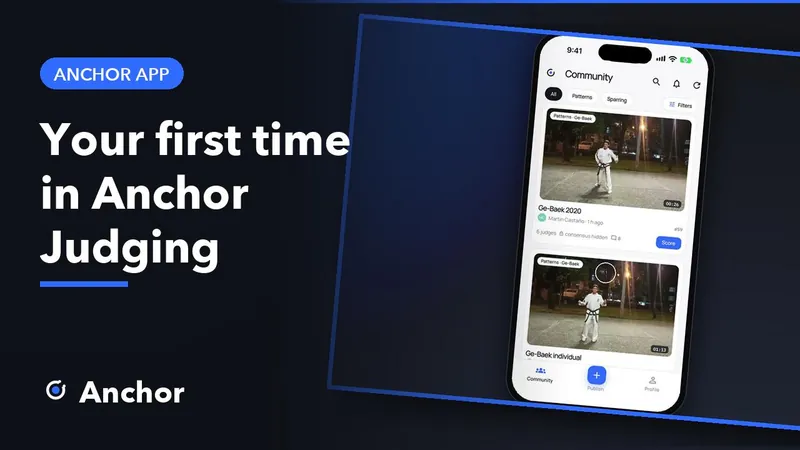
By scoring real videos in one pass and comparing your score with a reference. The Anchor app is free and has patterns and bouts already scored by a panel.
Sources
- ITF, Official ITF Rules of Competition, version 2026-1: umpire classes and requirements, requirements for world championships and World Cups, and the officials' duties.