How ITF sparring is scored: +1, +2, +3 and the winner
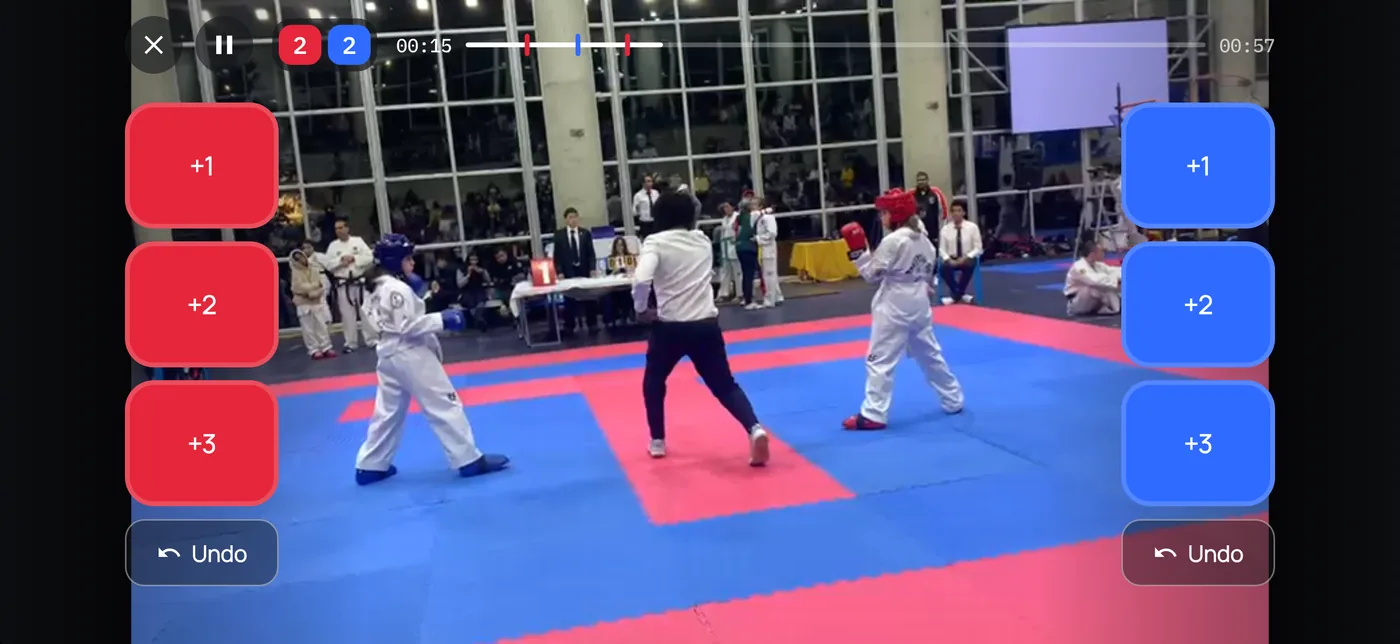
In ITF sparring no scoreboard decides on its own. Four corner umpires each count points on their own, from different angles, and each one votes for a winner. The competitor who convinces the majority wins.
This guide explains what each technique is worth, where it has to land, what makes it valid, how warnings and fouls take points away, and how the winner is decided when the panel does not agree.
Which rulebook. This guide follows the Official ITF Rules of Competition version 2026-1, published by the ITF at itftkd.sport. Other organisations also call themselves ITF and score differently: there are rulebooks with 4 and 5 points for mid-air kicks, points for defence and a compulsory mid-air kick per round. Always check your tournament's rulebook.
What each technique is worth
The points table is short and learnt in a minute:
| Technique | Target | Points |
|---|---|---|
| Hand attack | Middle or high | 1 |
| Foot attack | Middle (trunk) | 2 |
| Foot attack | High (head) | 3 |
The table is not the hard part. The hard part is deciding in a split second whether the technique was valid, whether it was hand or foot, and whether it reached the head or the shoulder.
Where it has to land
The rules define two targets:
- Head: front, sides and top. Not the back of the head, not the neck.
- Trunk: from shoulder to navel vertically, and out to a line running from the armpit down to the waist on each side. Front only: the back does not score.
An attack to any other area does not score. If it is unintentional, it is a warning. If it is intentional, it is a foul.
What makes a technique valid: light contact
ITF sparring is light contact. A technique scores when it meets three conditions at once:
- It is correctly executed.
- It is dynamic: delivered with strength, purpose, speed and precision.
- It is controlled on the target.
A technique that touches with no real intent does not score. One that lands hard does not either: heavy contact is a foul and excessive contact is a disqualification. That margin between "it landed" and "it landed as it should" is where four umpires see four different things.
Warnings: three take away a point
The centre referee is the only official who gives warnings and fouls. A warning is given for:
- Pretending to have scored by raising one or both arms.
- Stepping completely out of the ring.
- Falling, intentionally or not: any part of the body other than the feet touching the floor.
- Faking a blow or an injury to gain an advantage.
- Intentionally avoiding sparring.
- Adjusting equipment without the referee's consent.
- Unintentionally attacking outside the target area.
- Pushing with the hands, shoulders or body.
Three warnings automatically take away one point. If a competitor is pushed out of the ring on purpose, with no technique involved, the warning goes to whoever pushed.
Fouls: each one takes away a point
One point is taken away directly for:
- Heavy contact.
- Attacking a fallen opponent.
- Leg sweeping.
- Holding or grabbing.
- Intentionally attacking outside the target area.
- Unsportsmanlike conduct: ignoring the referee's directions, leaving the ring to run down the clock, inappropriate language or gestures.
Disqualification
A competitor is disqualified for, among other things:
- Misconduct against officials or ignoring their instructions.
- Uncontrolled or excessive contact.
- Three fouls given directly by the centre referee.
- Loss of temper, insulting, biting or scratching.
- Attacking with the knee, elbow or forehead.
- Competing under the influence of alcohol or drugs.
- Being found responsible for the opponent losing consciousness.
Duration and tie-breaks
At a world championship, individual sparring is two rounds of two minutes, with a one-minute break. At a World Cup, elimination bouts are one round: two minutes for coloured belts and three for black belts. Black belt finals go back to two rounds of two minutes.
In a draw, there is one more minute. If that is drawn too, the winner is the first point scored by at least two umpires at the same split second.
How the winner is decided
Each corner umpire scores what they see electronically, for red and for blue. At the end, the competitor ahead in that umpire's count takes their vote. The winner is the one with the majority of votes, with at least two in their favour.
That is why disagreement matters so much. Two umpires counting 8 to 6 and two counting 6 to 8 produce a draw, though they all watched the same bout.
Why four umpires count differently
- The angle. Each umpire sits at a corner. A body kick that looks clean from one side can land on the arm seen from the other.
- The speed. A hand-and-foot combination takes less than a second. Two techniques of different value have to be decided and marked in that time.
- The threshold. What is dynamic and controlled for one umpire was a brush for another. Neither is misreading the rules: each applies their own threshold.
A threshold is not corrected by reading. It is corrected by scoring the same bouts as other umpires and comparing, technique by technique.

Frequently asked questions
How many points is a head kick worth in ITF Taekwon-Do?
Three points, under the ITF's 2026-1 rules of competition. A kick to the trunk is worth two and a hand attack to the middle or high section is worth one.
Are jumping kicks worth more in ITF sparring?
Not in version 2026-1 of the ITF's rules: the value depends on hand or foot and on the target. Other organisations that also call themselves ITF do give extra points for mid-air techniques, so check each tournament's rulebook.
How many warnings lose a point?
Three warnings take away one point automatically. Fouls take away one point each, and three fouls given directly by the centre referee mean disqualification.
Who decides the winner of an ITF bout?
The corner umpires, by votes. Each votes for the competitor ahead in their count, and the winner is the one with the majority and at least two votes. In a draw, there is one more minute.
Does the centre referee award points?
The centre referee runs the bout and is the only official who gives warnings and fouls. The points are scored by the corner umpires.
Sources
- ITF, Official ITF Rules of Competition, version 2026-1: articles T32 to T38.
- Another ITF organisation, the one at itf-tkd.org, with 4 and 5 points for mid-air techniques: ITF Tournament Rules 2023, articles 55 to 57.