Record your pattern and get it scored by a panel before you compete
Your instructor watches you train every week. That is exactly why they are the worst person to tell you what a panel that does not know you would give you. Their eye is used to your pattern.
A tournament is something else: four umpires who see you for the first time, once, and deduct what they see. You can rehearse that before you compete: record your pattern and have it scored by a panel of judges and practitioners, with the same clicker and the same 0.2-per-mistake rule.
Why a panel and not an opinion
- A number, not a "looked good". Everyone who scores marks your mistakes as they happen and arrives at a score.
- The median of many, not one person's judgement. One very strict or very lenient judge barely moves the median.
- What they saw, and when. Comments can be pinned to the second of the video. If three people mark the same moment, that is your mistake.
How to record your pattern so it can be judged
A video that does not show the feet cannot be scored well. What judges need:
Framing
- Landscape, always.
- The whole body at all times, head to feet, high kicks included. Leave space above and to the sides.
- The starting spot in view. Returning to it, and on which foot, are two possible deductions.
- From the front, where the judges' table would be. Pattern umpires watch from the front, and patterns are designed to be seen from there.
The camera
- Still, on a tripod or propped up, at chest height. A handheld camera moves the background and hides the sine wave.
- No zooming during the performance. If you need to, move closer before you start.
- Light from the front or the side, never behind you. A window at your back turns you into a silhouette.
Sound
- Record with sound. Calling the pattern's name is part of the score, and a kihap costs points too, even at the end.
- No music over it. What can be heard is also judged.
The performance
- The whole pattern, uncut, from the moment you stand in position until you are back still on the starting spot.
- A single take. If you make a mistake, start over and record another. An edited video is not scored like a performance.
- In your dobok, as at the tournament.
People in the video
If anyone else appears in the video, or if the person performing is a minor, you need their permission, or a parent's or guardian's, to publish it. It is a condition of using the app, and it is the right thing to do.
What happens when you publish it on Anchor
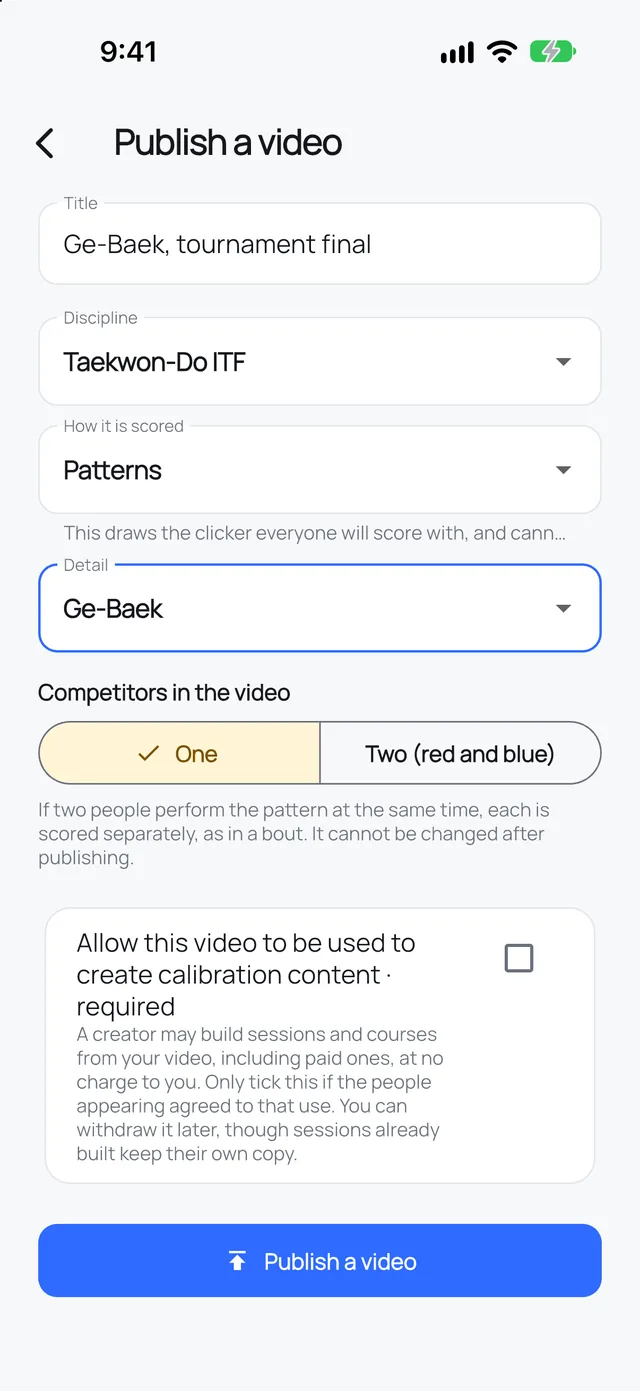
- You choose the video, give it a title and choose the way of scoring: ITF Taekwon-Do, patterns, and which pattern. That draws the clicker everyone will score you with.
- One or two competitors. If two people perform at once, each is scored separately, as red and blue.
- You accept the reuse licence. A creator may use your video in judge training sessions. It is required to publish.
- The video uploads in the background and appears on the community wall.
Then judges and practitioners score it with the clicker, in one pass with no pause. Each account scores it once and cannot edit its score. You cannot score your own.
How to read the result
The median
With at least five scores the consensus appears: the median of all the scores. Below five, a "consensus" would be the opinion of two or three people.
The spread
Look at how far apart the scores are. If almost all are close, the panel saw the same thing and the median is reliable. If they are far apart, there is something the panel does not see alike: a doubtful moment, or a video that does not show it well. It is worth recording again.
Who scored you and what they saw
As the video's owner you see who scored it, with their name, their score and their comment. Look for the moments that repeat. One comment on its own is an opinion. Three pointing at the same second are a correction.
What it does not tell you
The community's median is not an international umpire panel's. It is the median of the people who scored your video. It tells you where you stand against a real panel, and whether you improve from one video to the next.
Frequently asked questions
How much does it cost to publish a video on Anchor?
Nothing. Publishing videos and scoring in the community is free and needs no subscription.
How many people have to score my pattern before I see the consensus?
At least five. With fewer, the consensus is not shown, because it would be the opinion of too few people.
Where should I record a pattern from?
From the front, where the judges' table would be, with the camera still at chest height, in landscape, with the whole body and the starting spot in view.
Can I score my own video?
No. The author does not score their own, and each account scores each video once.
Who can see my video?
People with an Anchor account. You can share a link that shows the title, the score and a thumbnail, but watching and scoring the video requires an account.